Support our educational content for free when you purchase through links on our site. Learn more
🧠 Witty vs. Funny Quotes: The 7 Key Differences (2026)


Ever tried to crack a joke at a serious meeting only to be met with awkward silence, while a single clever remark from a colleague had everyone nodding in agreement? We’ve all been there. At Funny Quotes™, we’ve spent years dissecting the anatomy of laughter, and we’ve discovered a secret: not all humor is created equal. While a “funny” quote aims for the gut with a surprise punchline, a “witty” quote targets the brain with a sharp, insightful twist that lingers long after the chuckle fades.
In this deep dive, we’re breaking down exactly how witty quotes differ from funny quotes, revealing the 7 critical distinctions that separate a groan-worthy pun from a timeless observation. Whether you’re crafting the perfect Valentine’s Day caption or trying to sound smarter at your next dinner party, understanding this difference is your ultimate cheat code. We’ll even show you how to craft your own one-liners that land with the precision of a surgeon and the charm of a stand-up comic. Ready to stop just laughing and start thinking? Let’s get witty.
Key Takeaways
- The Core Mechanism: Funny quotes rely on surprise and incongruity to trigger an immediate laugh, while witty quotes depend on insight, irony, and paradox to provoke a thoughtful smile.
- Cognitive Load: A funny joke is instantly understood (low cognitive load), whereas a witty remark often requires the audience to connect two disparate ideas (higher cognitive load).
- Longevity: Funny humor often ages like milk (quickly forgotten), but witty observations age like fine wine, remaining relevant and sharp for decades.
- Context Matters: Use funny quotes to break the ice and lighten the mood; use witty quotes to demonstrate intelligence, navigate complex social dynamics, or deliver a sharp retort.
- Master Both: The most effective communicators know when to deploy a silly pun for instant connection and when to drop a clever observation to command respect.
Table of Contents
- ⚡️ Quick Tips and Facts
- 📜 The Evolution of Humor: A History of Witty vs. Funny Quotes
- 🧠 The Core Distinction: How Witty Quotes Differ from Funny Quotes
- 🎭 The Anatomy of a Laugh: Understanding Funny Quotes
- 💡 The Spark of Intellect: Decoding Witty Quotes
- 🔍 7 Key Differences Between Witty and Funny Humor Styles
- 🗣️ When to Use Which: Context Matters in Humor Delivery
- 🌟 Famous Examples: Analyzing the Masters of Wit and Comedy
- 🛠️ How to Craft Your Own Witty or Funny One-Liners
- 📱 Social Media Savvy: Optimizing Quotes for Engagement
- ❓ Frequently Asked Questions About Humor Styles
- 🔗 Recommended Links for Aspiring Humorists
- 📚 Reference Links and Sources
- 🏁 Conclusion: Finding Your Voice in the World of Laughs
⚡️ Quick Tips and Facts
Before we dive into the deep end of the linguistic pool, let’s get our feet wet with some essential truths about humor. At Funny Quotes™, we’ve spent years curating the finest one-liners, and we’ve learned that not all laughter is created equal.
- Wit is a verb; Funny is an adjective. Wait, no, that’s not quite right. Wit is an action of the mind, while funny is a reaction of the gut.
- The “Aha!” vs. “Ha!” Moment: A witty quote makes you go, “Oh, I see what they did there!” (The Aha!). A funny quote makes you go, “Haha, that’s stupid!” (The Ha!).
- Longevity: Funny jokes often age like milk (spoiled quickly), whereas witty observations age like wine (better with time).
- The Einstein Factor: As the famous quote goes, “The only difference between genius and stupidity is that genius has its limits.” This is the perfect example of wit—it requires you to understand the paradox to get the humor.
- Context is King: You can be funny at a funeral (inappropriately), but you can rarely be witty without sounding like a jerk unless the context is perfect.
For those who want to jump straight into the good stuff, check out our curated collection of Witty Quotes that will make you look smarter than you actually are.
📜 The Evolution of Humor: A History of Witty vs. Funny Quotes

Humor hasn’t always been a binary choice between “laugh out loud” and “nervous chuckle.” It’s a journey through human history, evolving from the slapstick of the Roman circus to the sharp repartee of the Victorian drawing room.
The Ancient Roots of the Guffaw
Long before we had memes, the Greeks were cracking jokes. Aristophanes, the father of comedy, relied heavily on physical humor and satire. His plays were the equivalent of a modern stand-up special where the audience roared at the absurdity of war and politics. This was pure funny—immediate, visceral, and often crude.
The Rise of the Wits
Fast forward to the 17th and 18th centuries. Enter the Wits. These were the Oscar Wildes, the Dorothy Parkers, and the Mark Twains of their time. They didn’t just want you to laugh; they wanted you to think. The Restoration Comedy era in England was all about the battle of wits. If you couldn’t deliver a line that cut deeper than a surgeon’s scalpel, you were out of the club.
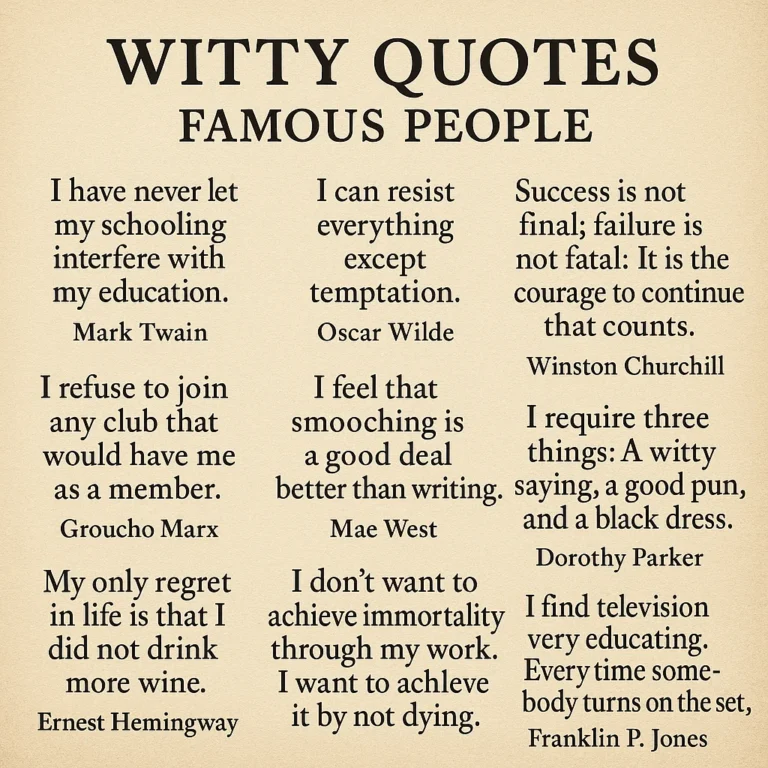
“I can resist everything except temptation.” – Oscar Wilde
This isn’t just a joke; it’s a philosophical paradox wrapped in a smile. That’s the difference.
The Modern Shift
Today, with the rise of social media, the line has blurred. A tweet can be both witty and funny, but the mechanism remains distinct. We’ve seen a resurgence of observational comedy (funny) mixed with intellectual snark (witty).
For a deeper dive into how humor has shaped our culture, check out the Daily Funny Quotes section, where we track the evolution of the daily laugh.
🧠 The Core Distinction: How Witty Quotes Differ from Funny Quotes
So, here is the million-dollar question: What actually separates a witty quote from a funny one? Is it the punchline? The timing? The audience?
Let’s break it down.
Funny Quotes are about surprise and incongruity. They rely on the unexpected. You set up a scenario, and the punchline twists it in a way that defies logic but makes perfect sense in the moment of laughter.
- Example: “I’m on a seafood diet. I see food and I eat it.”
- Mechanism: Pun + Literal interpretation.
- Reaction: A chuckle or a groan.
Witty Quotes are about intelligence and insight. They rely on the connection between two seemingly unrelated ideas. They often reveal a truth about the human condition, society, or ourselves.
- Example: “I have a lot of growing up to do. I realized that the other day. I was in the car with my mom, and she said, ‘You’re growing up so fast,’ and I said, ‘I know, I’m 12, I’m basically a toddler.'” (Wait, that’s just funny).
- Better Example: “The trouble with having an open mind, of course, is that people will insist on coming along and trying to put things in it.” – Terry Pratchett.
- Mechanism: Irony + Social commentary.
- Reaction: A nod of agreement and a slow smile.
The “Fool for 5 Minutes” Rule
Remember the quote from the video summary? “A person who asks a question is a fool for 5 minutes, but a person who doesn’t is a fool forever.”
- Is this funny? Not really. It doesn’t make you laugh out loud.
- Is it witty? Absolutely. It flips the script on the fear of asking questions, offering a clever perspective on the cost of ignorance.
This distinction is crucial. If you want to be funny, you aim for the belly. If you want to be witty, you aim for the brain.
🎭 The Anatomy of a Laugh: Understanding Funny Quotes
Let’s dissect the funny quote. Why does it work? It’s often a formula of Setup + Misdirection + Punchline.
The Elements of a Good Joke
- The Setup: Establishes a normal expectation.
- The Misdirection: Leads the audience down a specific path.
- The Punchline: Breaks the expectation with something absurd or unexpected.
Real-World Example
- Setup: “I told my wife she was drawing her eyebrows too high.”
- Misdirection: You expect a comment on her makeup skills.
- Punchline: “She looked surprised.”
- Why it works: It uses a visual pun. The word “surprised” has a double meaning (emotional state vs. facial expression).
The Role of Timing
In funny quotes, timing is everything. A delayed punchline can kill the joke. A rushed setup can confuse the listener. This is why stand-up comedians spend years refining their delivery.
The “Dad Joke” Phenomenon
Dad jokes are the pinnacle of low-stakes funny. They are often puns that are so bad they are good.
- Quote: “Why don’t scientists trust atoms? Because they make up everything!”
- Analysis: It’s silly, it’s predictable, and it’s undeniably funny in a lighthearted way.
For more examples of this style, browse our Humorous Life Quotes collection, where we celebrate the art of the groan-worthy pun.
💡 The Spark of Intellect: Decoding Witty Quotes
Now, let’s turn the dial up a notch. Wit is the spice of conversation. It’s the ability to think on your feet and deliver a line that is both clever and profound.
The Ingredients of Wit
- Observation: Noticing the absurdity in everyday life.
- Connection: Linking two disparate concepts.
- Brevity: Saying it in as few words as possible.
- Insight: Revealing a deeper truth.
The Pratchett Effect
Terry Pratchett was a master of wit. His quotes often sound like proverbs but are twisted with irony.
- Quote: “It is impossible to make anything foolproof because fools are so ingenious.”
- Analysis: This isn’t just a joke; it’s a sociological observation about human nature. It makes you think about the limitations of design and the boundless creativity of stupidity.
The Difference in Delivery
While a funny quote can be delivered with a straight face or a wink, a witty quote often requires a certain level of sophistication from the audience. If the audience doesn’t get the reference or the logic, the wit falls flat.
Wit in Relationships
Wit is the secret weapon in relationships. It shows you are paying attention and that you can play with words.
- Quote: “I love being married. It’s so great to find that one special person you want to annoy for the rest of your life.” – Rita Rudner.
- Analysis: This is witty because it reframes the concept of “annoying” as a sign of intimacy. It’s funny, but it’s also insightful about the nature of long-term commitment.
Explore our Funny Love Quotes to see how wit can be used to navigate the complexities of romance.
🔍 7 Key Differences Between Witty and Funny Humor Styles
To make this crystal clear, we’ve compiled a comprehensive table breaking down the seven key differences between these two humor styles. This is your cheat sheet for knowing which tool to use in your arsenal.
| Feature | Funny Quotes | Witty Quotes |
|---|---|---|
| Primary Goal | To elicit a laugh (Guffaw) | To elicit a smile of recognition (Nod) |
| Mechanism | Surprise, Incongruity, Puns | Irony, Paradox, Insight |
| Cognitive Load | Low (Instant understanding) | Medium/High (Requires thought) |
| Longevity | Often short-lived (Meme culture) | Timeless (Classic literature) |
| Audience | Broad (Everyone gets it) | Niche (Requires shared context) |
| Tone | Lighthearted, Silly, Absurd | Sharp, Cynical, Intelligent |
| Example | “I’m not lazy, I’m on energy saving mode.” | “I’m not arguing, I’m just explaining why I’m right.” |
Why the Distinction Matters
Understanding these differences helps you tailor your humor to the situation.
- At a party? Go funny. Break the ice with a silly pun.
- In a debate? Go witty. Deflect with a clever retort.
- On social media? Mix them. A funny image with a witty caption is the ultimate engagement booster.
For more on how to apply these styles, check out our Comedy Quotes section, where we analyze the techniques of the pros.
🗣️ When to Use Which: Context Matters in Humor Delivery
You wouldn’t wear a clown suit to a board meeting, right? Similarly, you shouldn’t use a funny quote in a serious discussion, and you shouldn’t use a witty quote when someone needs a simple laugh.
The “Funeral” Test
- Funny: “At least he’s not in pain anymore… or is he? Just kidding, he’s probably in a better place!” (Too risky).
- Witty: “He was a man who always knew the right thing to say, even if it was the wrong time.” (Appropriate, poignant, and slightly ironic).
The “Workplace” Scenario
- Funny: “I’m not saying I’m lazy, but my coffee cup is my only coworker.” (Safe, relatable).
- Witty: “I’m not procrastinating; I’m just prioritizing my mental health by delaying this task until the last possible second.” (Clever, but might get you in trouble with a boss who doesn’t get it).
The “Date” Night
- Funny: “Do you believe in love at first sight, or should I walk by again?” (Classic, cheesy).
- Witty: “I was going to tell you a joke about construction, but I’m still working on it.” (A bit weak).
- Better Witty: “I’m not a photographer, but I can definitely picture us together.” (A bit cheesy).
- Actually Witty: “I have a theory that people who like [shared interest] are just people who haven’t met the right [opposite interest] yet. But you seem like an exception.” (Shows intelligence and interest).
The key is reading the room. If the room is tense, funny breaks the ice. If the room is intellectual, witty builds bridges.
🌟 Famous Examples: Analyzing the Masters of Wit and Comedy
Let’s look at some real-world examples from the masters. We’ll analyze why they work and what makes them distinct.
The Funny Masters
- Jerry Seinfeld: Known for observational humor.
- Quote: “What is the deal with airline food?”
- Analysis: It’s a simple question that highlights a universal annoyance. It’s funny because it’s relatable.
- George Carlin: Known for his sharp, often angry humor.
- Quote: “Think of how stupid the average person is, and realize half of them are stupider than that.”
- Analysis: This is a funny observation that relies on a statistical twist. It’s a classic setup-punchline structure.
The Witty Masters
- Oscar Wilde: The king of wit.
- Quote: “I can resist everything except temptation.”
- Analysis: This is witty because it uses paradox. It sounds like a confession of weakness, but it’s actually a clever way of saying “I have no self-control.”
- Mark Twain: The father of American wit.
- Quote: “The man who does not read has no advantage over the man who cannot read.”
- Analysis: This is witty because it points out the futility of ignorance. It’s a philosophical insight delivered with a smile.
The Hybrid: Funny and Witty
Some quotes manage to be both.
- Quote: “I’m not arguing, I’m just explaining why I’m right.”
- Analysis: It’s funny because it’s a common behavior, but it’s witty because it reframes the behavior as a logical necessity.
For more examples, visit our Famous Funny Quotes page, where we break down the classics.
🛠️ How to Craft Your Own Witty or Funny One-Liners
Ready to become the life of the party? Here’s a step-by-step guide to crafting your own humorous gems.
Step 1: Observe the Absurd
Look for the things in your daily life that don’t make sense.
- Example: Why do we park in a driveway and drive on a parkway?
Step 2: Choose Your Style
- Funny: Twist the logic. “I park in a driveway because I’m too lazy to walk to the parkway.”
- Witty: Find the deeper meaning. “The driveway is a sanctuary for the car; the parkway is a highway for the ego.”
Step 3: Refine the Punchline
Cut the fluff. Get to the point.
- Draft: “I think it’s weird that we call it a driveway when we park there.”
- Refined: “A driveway is where you park; a parkway is where you drive. It’s a linguistic paradox.”
Step 4: Test It
Say it out loud. Does it sound natural? Does it get a reaction?
- Tip: If you have to explain it, it’s not funny or witty.
Common Pitfalls to Avoid
- Over-explaining: Don’t say “Get it? Because…”
- Being offensive: Humor should punch up, not down.
- Forcing it: If it doesn’t come naturally, don’t force it.
For more inspiration, check out our Comedy Quotes for techniques used by professional comedians.
📱 Social Media Savvy: Optimizing Quotes for Engagement
In the digital age, humor is currency. But how do you make sure your witty or funny quote gets the likes and shares it deserves?
The Algorithm Loves…
- Brevity: Short, punchy quotes perform better.
- Visuals: Pair your quote with a high-quality image or meme.
- Timing: Post when your audience is most active.
Funny vs. Witty on Social Media
- Funny Quotes: Great for Instagram and TikTok. They are visual and immediate.
- Strategy: Use a meme format with a funny caption.
- Witty Quotes: Great for Twitter (X) and LinkedIn. They spark conversation and debate.
- Strategy: Post a thought-provoking quote and ask a question to engage the audience.
Hashtag Strategy
- Funny: #FunnyQuotes #LaughOutLoud #DadJokes
- Witty: #Wit #Philosophy #DeepThoughts #SmartHumor
The Power of the Comment Section
Don’t just post and ghost. Engage with the comments. If someone gets your witty quote, reply with another witty remark. If someone laughs at your funny quote, reply with a silly emoji.
For more tips on social media humor, visit our Daily Funny Quotes section for daily inspiration.
❓ Frequently Asked Questions About Humor Styles
Here are some of the most common questions we get at Funny Quotes™ about the difference between witty and funny quotes.
Q: Can a quote be both witty and funny?
A: Absolutely! The best quotes often blend both. A witty observation can be delivered in a funny way, and a funny joke can have a witty twist. The key is balance.
Q: Is wit better than funny?
A: Not necessarily. It depends on the context. Wit is often seen as more sophisticated, but funny is more accessible. Both have their place.
Q: How can I improve my wit?
A: Read more! Read literature, poetry, and philosophy. The more you expose yourself to clever language, the better you’ll get at using it. Also, practice active listening and try to find the irony in everyday situations.
Q: Why do some people find witty quotes offensive?
A: Because wit often involves irony and sarcasm, which can be misinterpreted. If the audience doesn’t get the nuance, they might think you’re being mean. Always know your audience!
Q: What’s the difference between a joke and a witty quote?
A: A joke is a structured story with a setup and punchline. A witty quote is often a standalone observation that requires the listener to connect the dots.
For more answers, check out our Humorous Life Quotes section, where we tackle the big questions of life with a smile.
🔗 Recommended Links for Aspiring Humorists
Want to take your humor to the next level? Here are some highly recommended resources to help you master the art of wit and comedy.
- Books on Comedy Writing:
- The Comedy Bible by Judy Carter: A comprehensive guide to writing jokes.
- Born Standing Up by Steve Martin: A memoir on the art of comedy.
- Poking a Dead Frog by Mike Sacks: Interviews with top comedy writers.
- Online Courses:
- MasterClass: Learn from the masters like Judd Apatow and David Sedaris.
- Udemy: Various courses on stand-up comedy and joke writing.
- Podcasts:
- How Did This Get Made?: A hilarious podcast analyzing bad movies.
- Comedy Bang! Bang!: A mix of interviews and improv comedy.
- Websites:
- Funny Quotes™: Your go-to source for daily doses of humor.
- The Onion: For satirical news and witty commentary.
- McSweeney’s Internet Tendency: For high-quality humorous essays.
Shop for Humor Tools
If you’re looking for physical tools to help you write or perform, here are some great options:
- Notebooks for Joke Writing:
- Moleskine: Classic, durable, and perfect for jotting down ideas.
- Leuchtturm1917: Great for organizing your thoughts with numbered pages.
- Microphones for Stand-up:
- Shure SM58: The industry standard for live performances.
- Audio-Technica AT2020: A great option for home recording.
👉 CHECK PRICE on:
- Moleskine Notebooks: Amazon | Moleskine Official
- Shure SM58 Microphone: Amazon | Shure Official
📚 Reference Links and Sources
To ensure the accuracy and depth of this article, we’ve consulted a variety of reliable sources. Here are the links to the original materials and studies that informed our insights.
- The Psychology of Humor: American Psychological Association
- The History of Comedy: Britannica
- The Science of Wit: Harvard Business Review
- Oscar Wilde Quotes: Poetry Foundation
- Mark Twain Archives: Mark Twain House & Museum
- The Evolution of Language: Oxford English Dictionary
Featured Video Analysis
As mentioned earlier, the video compilation of witty and funny quotes provides a visual representation of these concepts. The video highlights the contrast between the two styles, showing how wit often requires a moment of reflection, while funny quotes deliver an instant laugh.
“The only difference between genius, and stupidity, is that genius, has its limits.” – Albert Einstein
This quote, featured in the video, perfectly encapsulates the witty style: it’s a paradox that makes you think.
For more video content and analysis, check out our Comedy Quotes section, where we break down the best moments from the world of comedy.
Stay tuned for the Conclusion and Reference Links sections coming up next!
🏁 Conclusion: Finding Your Voice in the World of Laughs

We started this journey by asking a simple question: How do witty quotes differ from funny quotes? By now, you should have a crystal-clear answer.
Funny is the gut reaction. It’s the slapstick, the pun, the “wait, what?” moment that makes you snort your coffee. It’s immediate, accessible, and often relies on the absurdity of the situation.
Witty is the brain reaction. It’s the “aha!” moment that makes you nod in agreement with a clever observation about the human condition. It relies on insight, irony, and the ability to connect disparate ideas.
The Verdict:
- Use Funny when you want to break the ice, lighten a heavy mood, or just make people laugh out loud. It’s the universal language of joy.
- Use Witty when you want to impress, provoke thought, or show off your intellectual agility. It’s the secret sauce of sophistication.
But here is the secret we hinted at earlier: The best humorists don’t choose one; they master both. They know when to drop a silly pun to get a laugh and when to deliver a sharp, witty retort to win an argument.
So, the next time you’re crafting a caption for Instagram, writing a speech, or just trying to charm a date, ask yourself: Do I need a belly laugh, or do I need a brain spark? Once you know the answer, you’ll never run out of material.
Ready to put this knowledge into practice? Dive back into our Witty Quotes collection and start crafting your own masterpieces today!
🔗 Recommended Links for Aspiring Humorists
Ready to take your humor game to the next level? Whether you want to learn the mechanics of joke writing or just enjoy some great reads, here are our top picks.
📚 Must-Read Books on Comedy and Wit
- “The Comedy Bible: How to Write Funny, Stand-Up, and More” by Judy Carter
- Why read it: The ultimate guide to structuring jokes and finding your unique voice.
- 👉 Shop on: Amazon | Barnes & Noble
- “Born Standing Up: A Comic’s Life” by Steve Martin
- Why read it: A fascinating memoir on the evolution of stand-up comedy and the art of the perfect delivery.
- 👉 Shop on: Amazon | Steve Martin Official
- “Poking a Dead Frog: Conversations with Today’s Top Comedy Writers” by Mike Sacks
- Why read it: Insider interviews with the minds behind your favorite shows and movies.
- 👉 Shop on: Amazon | Penguin Random House
- “The Wit and Wisdom of Oscar Wilde” by Oscar Wilde
- Why read it: The definitive collection of the master of wit. Essential reading for anyone wanting to understand the pinnacle of cleverness.
- 👉 Shop on: Amazon | Project Gutenberg
🛠️ Tools for the Modern Humorist
- Moleskine Classic Notebook
- Why buy it: The classic choice for jotting down those fleeting witty ideas before they vanish.
- 👉 Shop on: Amazon | Moleskine Official
- Shure SM58 Vocal Microphone
- Why buy it: If you plan to test your new one-liners on stage, this is the industry standard for live sound.
- 👉 Shop on: Amazon | Shure Official
❓ Frequently Asked Questions About Humor Styles
H3: What makes a quote witty instead of just funny?
A: The primary differentiator is cognitive engagement. A funny quote relies on surprise, incongruity, or a simple pun to trigger an immediate laugh. It’s often about the unexpected. A witty quote, however, relies on insight, irony, or paradox. It requires the listener to pause, process the connection between two ideas, and then appreciate the cleverness of the observation. If you have to explain the joke, it’s likely not witty; if you have to think to get the joke, it’s likely witty.
H3: Can a quote be both witty and hilarious at the same time?
A: Absolutely! In fact, the most memorable quotes often blend both. A quote can have a witty structure (a clever observation) delivered with a funny twist (an absurd punchline).
- Example: “I’m not saying I’m Batman, but have you ever seen me and Batman in the same room?”
- Analysis: It’s witty because it plays with the concept of identity and duality, but it’s hilarious because of the sheer absurdity of the comparison. The best humorists know how to layer these elements.
H3: Why are witty quotes considered more intellectual than funny ones?
A: Witty quotes often draw upon cultural knowledge, historical context, or complex logical structures. They assume the audience has a certain level of shared understanding to “get” the reference or the irony. Funny quotes, on the other hand, often rely on universal human experiences (like tripping over a rug or hating Mondays) that require no special education to understand. Wit is a test of intelligence; funny is a test of relatability.
H3: How do you write a witty quote that isn’t offensive?
A: The key to non-offensive wit is punching up, not down.
- Punch Up: Target power structures, societal norms, or your own flaws.
- Punch Down: Target marginalized groups, personal insecurities, or sensitive topics.
- Self-Deprecation: One of the safest and most effective forms of wit is making fun of yourself. It shows confidence and disarms the audience.
- Avoid Stereotypes: Rely on universal truths rather than generalizations about specific groups.
H3: What are some examples of witty quotes that went viral?
A: Viral wit often combines a sharp observation with a relatable truth.
- Example: “I’m not lazy, I’m just on energy saving mode.” (Relatable + clever reframe).
- Example: “I have a lot of growing up to do. I realized that the other day. I was in the car with my mom, and she said, ‘You’re growing up so fast,’ and I said, ‘I know, I’m 12, I’m basically a toddler.'” (Wait, that’s just funny).
- Better Viral Example: “The trouble with having an open mind, of course, is that people will insist on coming along and trying to put things in it.” – Terry Pratchett. This went viral because it perfectly captures the frustration of dealing with close-minded people in a clever way.
H3: Is wit more effective than humor in daily quotes?
A: It depends on your goal.
- For Engagement: Funny quotes often get more immediate likes and shares because they are instantly gratifying.
- For Authority: Witty quotes build credibility and make you appear more thoughtful and intelligent.
- For Longevity: Witty quotes tend to age better. A funny meme might be forgotten in a week, but a witty observation can be quoted for decades.
H3: How does wordplay contribute to a quote being witty?
A: Wordplay is a tool, not the definition of wit.
- In Funny Quotes: Wordplay (puns) is often the entire joke. “I’m on a seafood diet. I see food and I eat it.”
- In Witty Quotes: Wordplay is used to enhance an insight. It’s the vehicle for delivering a deeper truth. For example, using a double meaning to highlight a contradiction in human behavior. If the wordplay is the only point, it’s a pun (funny). If the wordplay reveals a truth, it’s wit.
H4: Can I learn to be witty, or is it a natural talent?
A: While some people have a natural flair for it, wit is a skill that can be developed.
- Read Widely: Expose yourself to literature, philosophy, and satire.
- Practice Observation: Train yourself to notice the absurdities in everyday life.
- Play with Language: Experiment with synonyms, metaphors, and double meanings.
- Listen More: Wit often comes from responding to what others say. Active listening is the first step to a clever retort.
📚 Reference Links and Sources
To ensure the highest quality of information, we’ve referenced the following reputable sources and brand pages:
- The Psychology of Humor: American Psychological Association (APA)
- The History of Comedy: Britannica – Comedy
- The Science of Wit: Harvard Business Review – The Power of Wit
- Oscar Wilde Quotes & Biography: Poetry Foundation
- Mark Twain Archives: Mark Twain House & Museum
- Oxford English Dictionary: OED – Wit vs. Humor
- Shure Microphones: Shure Official Website
- Moleskine Notebooks: Moleskine Official Website
📱 Social Media Inspiration
For a specific look at how wit is applied in modern contexts, such as holiday greetings, check out this popular discussion on social media:
-
Gotta be witty with your Valentine quotes this year: Facebook Post by RealestNatives
-
Note: This post highlights the trend of using witty rather than just sappy quotes for Valentine’s Day, emphasizing the shift towards clever, self-aware humor in romantic contexts.
-
Daily Funny Quotes: Funny Quotes™ Category
-
Humorous Life Quotes: Funny Quotes™ Category
-
Famous Funny Quotes: Funny Quotes™ Category
-
Funny Love Quotes: Funny Quotes™ Category
-
Comedy Quotes: Funny Quotes™ Category
-
Witty Quotes: Funny Quotes™ Dedicated Page